
Flexible polyurethane foam is one of the most versatile cushioning materials used across automotive, furniture, seating, bedding and industrial applications. Its combination of softness, resilience, lightweight construction and customizable performance makes it suitable for products ranging from vehicle seats and armrests to furniture cushions and specially moulded industrial components.
Also commonly known as flexible PU foam, the material can be engineered in different densities, firmness levels and shapes depending on the intended application. This flexibility allows manufacturers to develop foam components around specific comfort, support, dimensional and performance requirements.
Flexible polyurethane foam typically has an open-cell structure that allows it to compress and recover while providing cushioning and support. Industry sources describe applications across furniture, bedding, transportation, packaging, footwear, medical products and other specialty uses.
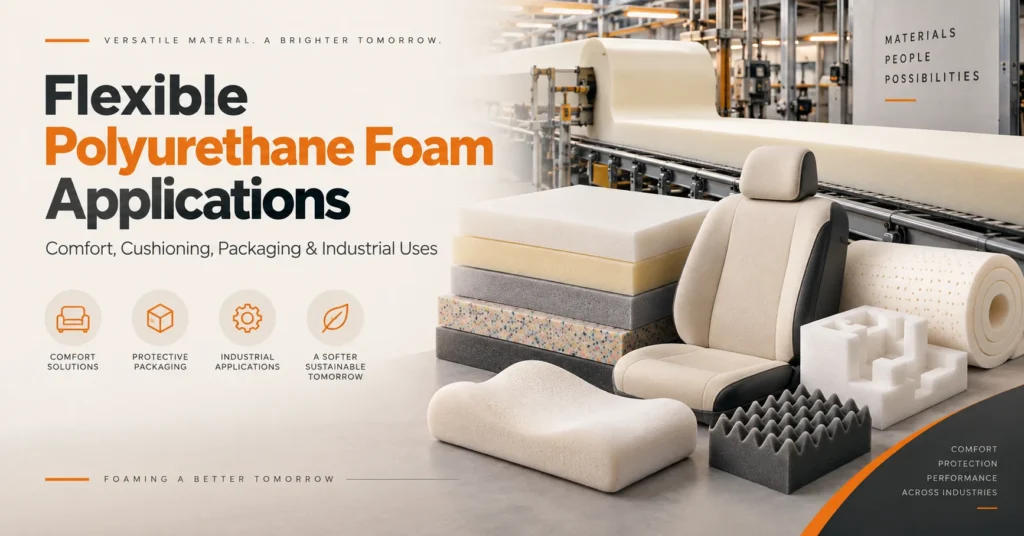
What Is Flexible Polyurethane Foam?
Flexible polyurethane foam is a polymeric foam generally produced through the reaction of polyols and isocyanates along with other components used to control the foaming process and final material characteristics. The formulation and manufacturing conditions can be adjusted to produce different levels of density, firmness, resilience and durability.
Unlike rigid polyurethane foam, which is primarily engineered for stiffness and insulation, flexible foam is designed to compress under load and recover after the pressure is removed.
That makes flexible foam polyurethane particularly useful where cushioning, comfort, impact absorption or adaptable support is required.
For manufacturers and product designers, this ability to modify foam characteristics is one of its major advantages. Rather than using one standard foam for every application, the foam can be selected or engineered around the demands of the final component.
Key Properties of Flexible PU Foam
Flexible PU foam is widely selected because several useful characteristics can be combined within a relatively lightweight material.
Depending on the formulation and manufacturing process, important characteristics can include:
- Adjustable firmness and density — foam can be engineered for soft cushioning or firmer support.
- Resilience and recovery — the material can compress under load and return toward its original form.
- Lightweight construction — useful where component weight is important.
- Cushioning and impact absorption — helps distribute loads and improve comfort.
- Shape flexibility — foam can be cut, shaped or moulded depending on the product.
- Comfort and support — especially valuable in seating, furniture and bedding applications.
- Application-specific performance — physical characteristics can be tailored according to product requirements.
Flexible polyurethane foam is classified and evaluated using properties such as density, durability, firmness, tear resistance and surface elasticity, among other characteristics.
Where Is Flexible Polyurethane Foam Used?
The versatility of flexible polyurethane foam allows it to serve both consumer and industrial markets.
Automotive and Transportation
Transportation is one of the important application areas for flexible PU foam.
It can be used in components such as:
vehicle seat cushions, backrests, armrests, headrests, interior padding and other comfort or vibration-management components.
Flexible polyurethane foam is widely used in automotive seating and interior applications because manufacturers can balance cushioning, comfort, resilience and component shape. The Polyurethane Foam Association identifies automotive seating, headliners, trim, vibration/noise control and other transportation components among common flexible foam applications.
For railway and commercial transportation seating, similar properties make PU foam useful where passengers require comfort while the component also needs consistent performance during repeated use.
Furniture and Seating
Furniture is another major application.
Flexible polyurethane foam can be used in:
sofa cushions, chair seats, back cushions, office seating, armrests and upholstered furniture components.
Its firmness can be adjusted for the desired seating feel, while its lightweight structure makes it practical for furniture manufacturing.
Industry guidance notes that flexible foam is commonly used for furniture seats, backs, arms and trim and can be customized for different applications.
Bedding and Comfort Products
Flexible PU foam is widely used in mattresses, pillows, mattress toppers and comfort layers.
Different foam formulations can produce different levels of softness, support and recovery. Flexible polyurethane foam can therefore be used alone or alongside other materials as part of a layered comfort system.
Memory foam is also part of the broader family of polyurethane-based flexible foams, although its slow-recovery characteristics distinguish it from conventional high-resilience foam.
Packaging and Protection
Flexible foam can also protect products during transportation.
Its cushioning characteristics make it suitable for:
protective inserts, equipment packaging, component separators and customized cushioning.
Foam can be shaped around sensitive products to help absorb shock and reduce direct contact during movement. The Polyurethane Foam Association includes custom-shaped protective packaging for electronics and instruments among common applications.
Industrial Applications
Flexible polyurethane foam is not limited to comfort products.
Industrial applications may require foam for cushioning, vibration control, protective components, ergonomic support or specially shaped parts.
The exact foam specification should therefore depend on the operating conditions and functional requirements of the finished component rather than simply choosing foam based on appearance or softness.
What Is Flexible Polyurethane Molding?
Flexible polyurethane molding is a manufacturing method in which polyurethane material is introduced into a mould and allowed to form the required component shape.
This is particularly useful when a manufacturer needs a component with controlled geometry, repeatability or a shape that would be difficult to achieve efficiently by simply cutting foam from a large block.
Flexible polyurethane foam can broadly be manufactured as slabstock foam that is later cut and processed, or as moulded foam produced directly inside a mould. Moulded production can be useful for complex shapes and repeatable dimensional requirements.
For example, moulded flexible PU foam may be considered for applications such as automotive seating components, specialized cushions and other components requiring defined contours.
Moulded Foam vs Cut Foam
The right manufacturing approach depends on the product.
Cut foam can be practical when relatively simple geometries are required. Large foam blocks or sheets can be converted into the required dimensions and profiles.
Moulded flexible polyurethane foam, on the other hand, can be more suitable for products that require specific curves, contours, integrated shapes or repeatable production.
Neither approach is universally better. The correct choice depends on factors such as component design, expected production quantity, dimensional requirements, material characteristics and end-use performance.
Benefits of Flexible Polyurethane Foam
One reason flexible polyurethane foam is used across such different industries is that manufacturers can balance multiple product requirements within the same material family.
Customizable Comfort and Firmness
Not every seat, cushion or industrial component requires the same firmness.
Flexible foam formulations can be adjusted to achieve different performance levels, allowing manufacturers to select a material according to the intended use.
Design Flexibility
Flexible polyurethane foam can be produced and processed into many different shapes.
This supports both conventional cushioning products and application-specific industrial components.
Lightweight Performance
Foam can provide useful cushioning without introducing the weight associated with some traditional support materials.
This can be valuable in transportation and other applications where overall component weight matters.
Consistent Component Production
With the appropriate formulation, tooling and manufacturing controls, moulded polyurethane components can be repeatedly produced for defined product requirements.
Wide Range of Applications
One flexible foam family can support applications spanning transportation, furniture, bedding, packaging, footwear and specialized industrial products.
How to Choose the Right Flexible PU Foam
Choosing flexible polyurethane foam should begin with the requirements of the final application.
Instead of asking only, “What density foam do I need?”, manufacturers should consider how the component will actually be used.
Important factors can include expected load, required firmness, recovery characteristics, component dimensions, shape, frequency of use, comfort requirements and environmental or operating conditions.
For seating, for example, comfort and resilience may be major priorities.
For an industrial component, dimensional consistency or repeated compression performance may be more important.
And for a moulded automotive component, the required geometry and integration with surrounding parts may influence both material selection and manufacturing method.
This is why working with experienced flexible polyurethane foam manufacturers can be useful when the requirement goes beyond a standard foam sheet or cushion.
Flexible PU Foam vs Rigid PU Foam
Flexible and rigid polyurethane foams belong to the same broad polyurethane family but are designed for very different purposes.
Flexible PU foam is typically selected for applications where compression, cushioning, resilience and comfort are required.
Rigid PU foam is significantly stiffer and is commonly associated with thermal insulation and structural-type applications.
In simple terms:
Flexible PU Foam → comfort, cushioning, resilience and adaptability
Rigid PU Foam → insulation, stiffness and dimensional stability
Understanding this distinction prevents a product from being specified with the wrong type of polyurethane foam.
Why Customization Matters in Flexible Foam Manufacturing
Two products may both use flexible polyurethane foam but require completely different material behavior.
A vehicle seat, office chair cushion and protective industrial insert can differ significantly in:
required firmness, density, thickness, shape, resilience and expected service conditions.
For this reason, flexible PU foam manufacturing is often less about selecting a generic material and more about matching the material and manufacturing process to a specific application.
A well-defined project normally begins with the component requirements, followed by foam selection, prototyping or mould development where necessary, production and quality verification.
Flexible Polyurethane Foam Solutions from Aarti Enterprises
Aarti Enterprises provides polyurethane foam solutions for automotive, railway, furniture and industrial applications.
Our approach focuses on understanding the end-use requirement before selecting the appropriate foam type and production method.
Depending on the project, requirements may involve different densities, firmness levels, dimensions or moulded component designs.
If you are evaluating a new flexible PU foam component or looking for a solution tailored to an existing product, sharing the application details, dimensions and expected performance requirements is the best starting point.
Explore our Flexible Polyurethane Foam solutions or contact our team to discuss your application.
Frequently Asked Questions About Flexible Polyurethane Foam
Flexible polyurethane foam is a lightweight, resilient foam material designed primarily for cushioning, comfort, support and impact absorption. Its properties can be adjusted for different product requirements.
Flexible PU foam is commonly used in automotive seating, railway seating, furniture, mattresses, cushions, packaging and a variety of industrial components.
Yes. Flexible polyurethane foam can be produced through moulding when defined shapes or repeatable component geometries are required. It can also be manufactured as slabstock foam and subsequently cut or processed.
Yes. Flexible foam can be produced with different physical characteristics depending on its intended application, including different density and firmness levels.
Look for a manufacturer capable of understanding the application requirements rather than supplying only a generic foam specification. Discuss the required dimensions, firmness, density, shape, production volume and expected performance before finalizing the material.